“Emergency stop.” Then nothing moves until an explicit re-arm
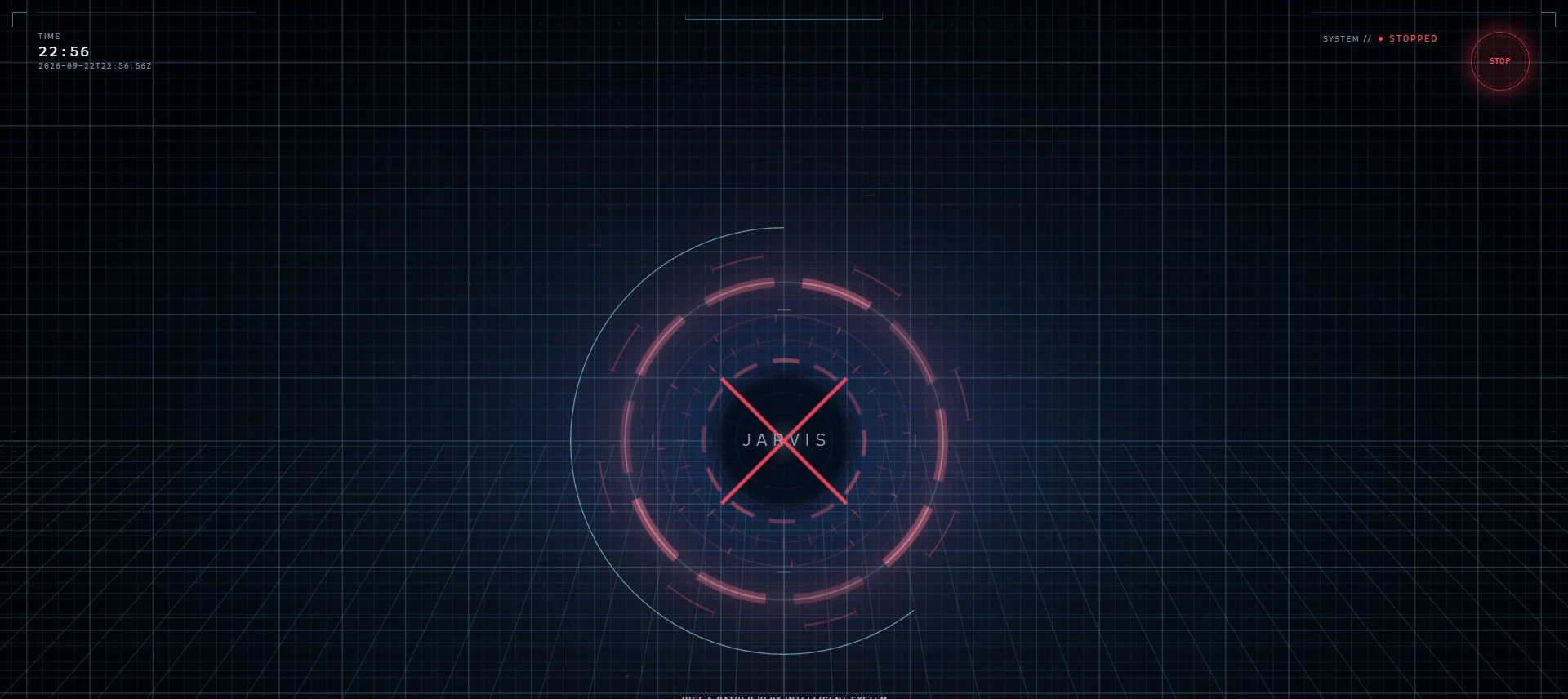
A typed “Emergency stop.” took a 420 ms turn. The HUD went red and STOPPED and stayed latched. JARVIS was shut down, restarted with an explicit re-arm, and reported HEALTHY 41 s after relaunch.
LIVE-PROVEN, rung 6 of 8What this run supports. Recorded 22 September 2026.
Real capture22 Sept 2026system21 s1080p · 60 fps
Asked: “Emergency stop.”
Real capture, captured 22 September 2026. “Emergency stop.” took a 420 ms turn; the HUD went to STOPPED and stayed latched. JARVIS was shut down, restarted with --rearm, and came back HEALTHY 41 s after relaunch.ShowsThe E-stop is reachable by a plain request, and it stayed latched until an explicit re-arm at restart.Does not showNothing physical was running, so this does not show what the stop interrupted.What happens, step by step
0:00 Asked: “Emergency stop.”
0:03 Stopped within a 420 ms turn · the latch holds until an explicit re-arm
0:11 Shut down cleanly, then restarted with --rearm
0:14 Back up: every consulted producer answered · HEALTHY
Captured at revision 893913a9c
Real capture22 Sept 2026system
Real capture, captured 22 September 2026. After “Emergency stop.”: everything stopped and latched until an explicit re-arm.
Captured at revision 893913a9c
Asked
What was asked
Emergency stop.
Result
What happened
The E-stop is handled before anything else and needs no approval. The turn completed in 420 ms. The HUD core turned red and crossed out, the system cell read STOPPED, a STOP control lit, and presence reported estopped. The latch held. JARVIS was shut down cleanly through its own launcher, restarted with --rearm (which clears the latch deliberately), and came back with the system cell reading HEALTHY: every consulted producer answered inside its window.
Pipeline
Architecture path
01Typed request
02E-stop, handled first
03HUD STOPPED, latched
04Clean shutdown
05Explicit re-arm at start-up
06HEALTHY
What this proves
The E-stop is reachable by a plain request and takes effect in well under a second of turn time.
The stop stayed latched: the HUD remained STOPPED until JARVIS was shut down and restarted with an explicit re-arm.
After the re-arm the system reports its health from live producers, not from a default.
What it does not prove
Nothing physical or long-running was active, so this does not show what the stop interrupted. An earlier demo covers an E-stop during a GPU render.
420 ms is the whole typed turn, not the time for every owned process to settle.
Recorded on 2026-09-22.
Timeline (UTC)
Moment
Time
“Emergency stop.” sent
22:56:50.5
Turn complete
420 ms later
Clean shutdown
22:57:17
Relaunched with re-arm
22:57:29
Listening again, HEALTHY
22:58:10
Why the latch matters
A stop that quietly expires is a pause. Here the stop survives until the owner deliberately re-arms at start-up, and the HUD makes the stopped state impossible to miss.