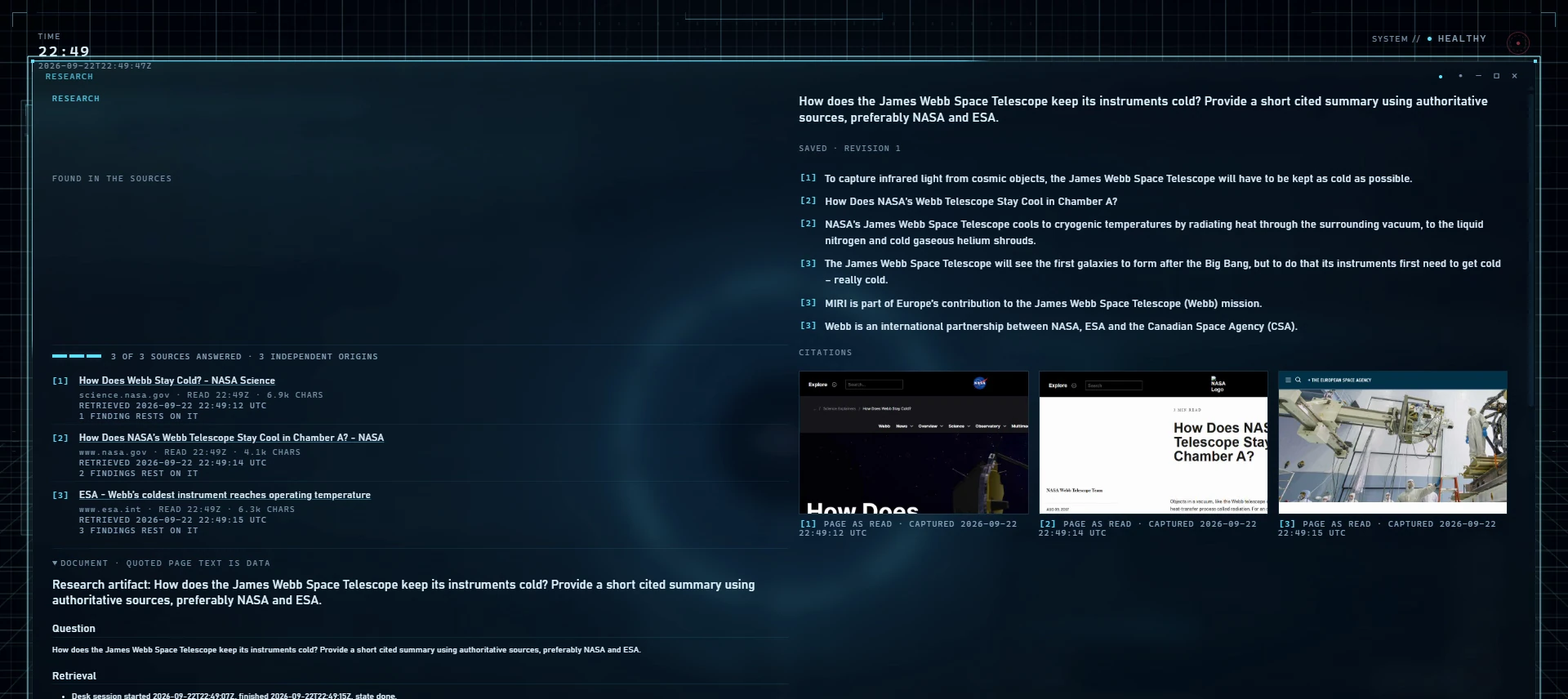
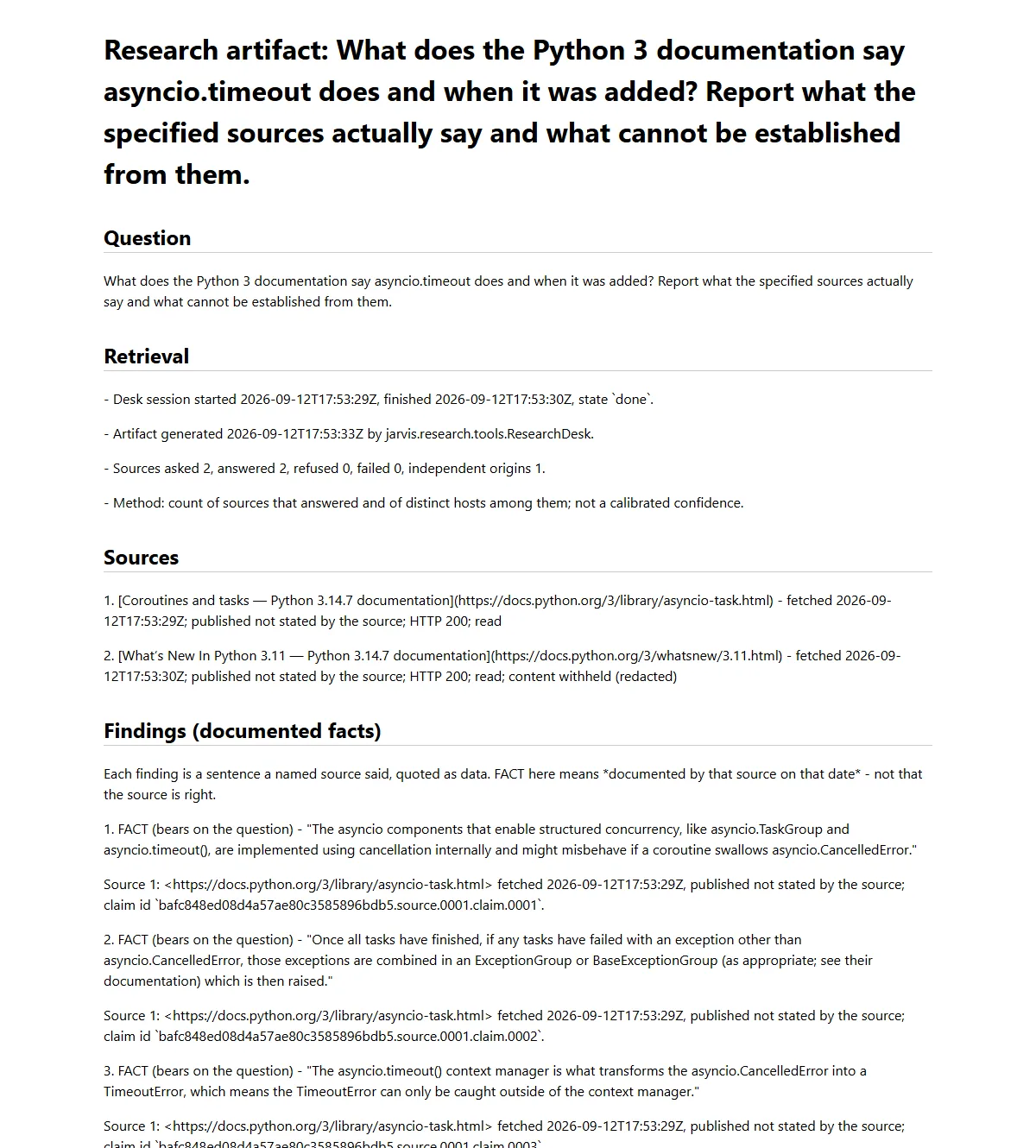
A research answer is only as good as the reader’s ability to tell how strong it is. JARVIS’s research system is built to preserve that strength signal from the first page fetched to the sentence spoken. The same discipline extends to its predictions: it records what it expects before it acts, so its confidence can be checked later.
Browsing without exposure
ResearchDesk browses in an isolated Playwright context, separate from the owner’s own browser session. It obeys robots.txt and refuses private network hosts, so a page cannot steer it into the owner’s local network. Research adapters never execute a tool and never grant authority. Text on a web page is evidence to weigh, not an instruction to follow.
Evidence and the claim graph
Each source becomes an Evidence record, and claims and their support are held in a ClaimGraph. Support is graded, and the grading is deliberately conservative:
- Lexical checks are capped at CONSISTENT. When a check finds a claim’s words in a source, the most it can say is that the claim is consistent with the source. The project’s rule is that “a keyword match must never be laundered into ‘verified’”.
- Only an entailment model may say ENTAILED, meaning the source actually implies the claim.
- A retracted source supports nothing. Anything that rested on it loses that support.
Why cap keyword matching? A sentence can contain every word of a claim and still say the opposite: “the study did not find that X causes Y”. Treating word overlap as proof would inflate confidence exactly where it is least deserved.
TRIBUNAL: counting origins, not documents
Contested questions go to TRIBUNAL, which has prosecution, defence, provenance and judge roles. The judge weighs independent origins, not the number of documents: “Five documents citing one study are one source wearing five hats.” A ruling is UPHELD, CONTESTED, UNSUPPORTED or WITHDRAWN, and each ruling states what evidence would change it.
Stating what would change a ruling makes it falsifiable. It also tells the owner what to look for if they disagree.
Four kinds of card
Every result card is classified by the EpistemicEngine as one of four kinds:
| Kind | Meaning |
|---|---|
| FACT | Supported by evidence strong enough to state directly |
| INFERENCE | Reasoned from evidence, not observed directly |
| RECOMMENDATION | A suggested course, open to the owner’s judgment |
| ACTION | Something to be done, which still has to pass governance |
The same classification feeds the daily briefing. There, actions rank above recommendations, recommendations above inferences, and inferences above facts. In speech, answers are marked as confirmed, inferred, incomplete or unknown.
Calibration
A system that says “90% sure” should be right about nine times in ten. JARVIS’s calibration module records each prediction before its outcome is known, then scores the predictions once outcomes arrive. It uses two standard measures:
- Brier score: the average squared gap between the stated probability and what happened.
- Expected calibration error (ECE): how far stated confidence drifts from observed accuracy across confidence bands.
No calibration figure is published from fewer than 20 samples, because a handful of predictions can look perfectly calibrated by chance. Recording before the outcome matters just as much: a prediction written down afterwards cannot be honestly scored.
Hypotheses and experiments
A hypothesis module ranks competing explanations and plans the next experiment by expected information gain, the test whose result would most change the ranking. PROMETHEUS, a deterministic invention pipeline, generates candidate ideas. Its records never auto-promote into owner memory, so a brainstorm cannot become a remembered “fact”. See memory.
Predict-before-act is a behaviour, not a layer
The phrase “predict before act” describes something JARVIS does, but no production component has that name, and this site does not present it as one. The behaviour appears in several places:
- Calibration records a prediction before the outcome.
- A mission can be simulated before it runs. The result is labelled SIMULATED / not_proof, and “Simulation never grants authority or certifies effects.” See missions.
- Pre-mortems run before execution.
- The anticipation component makes predictions, but “A PREDICTION NEVER REACHES THE EXECUTOR”.
- On the Advanced branch, which is not merged into production, the operator lane binds experiment predictions to the receipts that later observe them.
The Advanced work is still unfinished. Its item “record prediction before dispatch” is open for integration, and a matrix row named “Predict-Before-Act Simulation Layer” has not been dispositioned. As a layer, predict-before-act is a concept with partial pieces.
What is not proven yet
- Live research readings are historical. They come from 16 September 2026 and a journey reading before 17 September 2026.
- TRIBUNAL, calibration and PROMETHEUS are tested, not live-proven, and no calibration figure is published here.
- Repository analysis and video research are blocked in the registry.
- Entailment grading depends on an entailment model. This page does not claim how often that model is right.
- Predict-before-act is not a unified layer. Its Advanced-branch pieces are lane-level and unmerged.