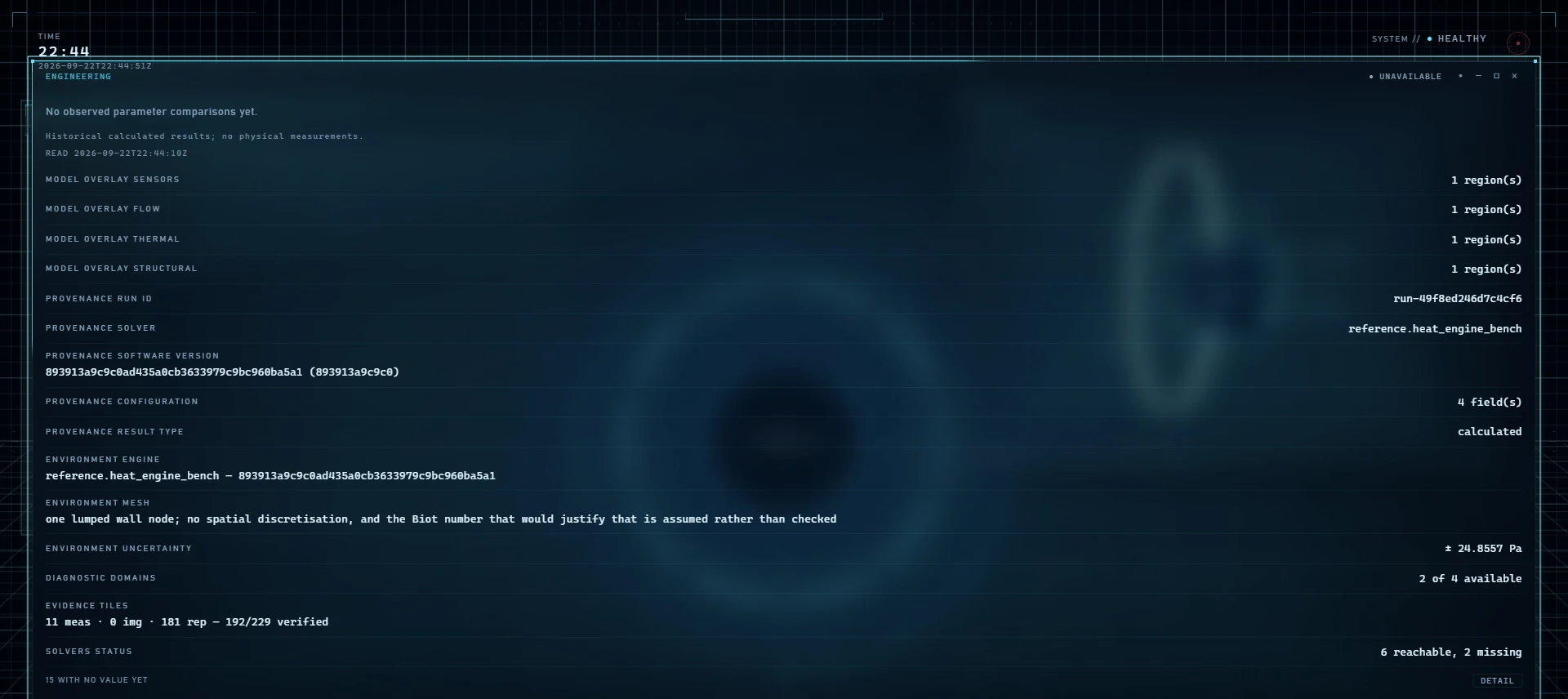
The maximised engineering panel: model overlays, provenance run ID, solver reference.heat_engine_bench, software version, result type calculated, a lumped-wall mesh note, uncertainty, and solver status 6 reachable, 2 missing.

Engineering, CAD and fabrication

Unit-safe engineering maths, solver runs, journaled CAD operations, a 3D engineering scene and print preparation, kept strictly apart from physical printing. Every result is labelled as a calculation, simulation, estimate, measurement or physical result, and those labels never merge.

TESTED , rung 3 of 8 Unit-safe quantities were recorded LIVE on 17 September 2026 (historical) and a CalculiX solve is TESTED. CAD, the 3D scene, trade spaces and STEP slicing exist only on the unmerged Advanced branch. Physical printing is a concept by design: the final send always refuses.

PARTIAL Parts of this system sit at different rungs. The breakdown below shows each one.

As of
Parts tracked
9
Catalogued capabilities
27
On the unmerged branch
5
Real capture, captured 22 September 2026. JARVIS ran the thermal_bench case (run-8a6b69c66acd4dbe): efficiency 0.31358, 593.15 K, 376.296 W, 1.269 GPa, all labelled calculated. The whole turn took 5.1 s. ShowsA request reaches a real solver through the policy check, and the result is published with its provenance and stated assumptions. Does not showCalculated, not measured. The panel’s provenance run ID lagged the new run until a restart.
What happens, step by step
  1. 0:00 Asked: “Run the thermal bench simulation and show me the engineering results.”
  2. 0:07 Solver run published: provenance, solver, software revision, stated assumptions
  3. 0:16 The digital twin the readings belong to

Captured at revision 893913a9c

The maximised engineering panel: model overlays, provenance run ID, solver reference.heat_engine_bench, software version, result type calculated, a lumped-wall mesh note, uncertainty, and solver status 6 reachable, 2 missing.
Real capture, captured 22 September 2026. What a published solve carries: its run, solver, software revision, result type, the model’s own simplification and its uncertainty.

Captured at revision 893913a9c

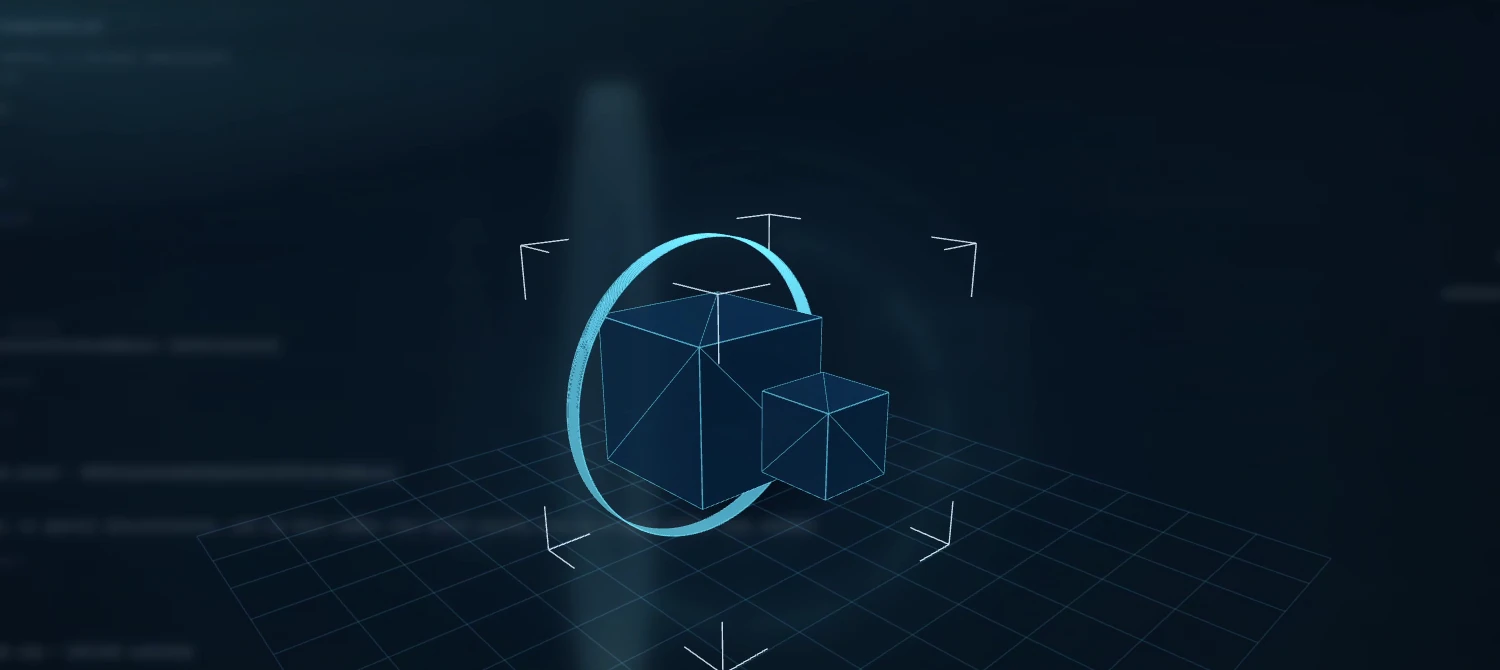
A 3D wireframe model of boxes and a ring on a grid, labelled twin/model.glb, 2,058 triangles.
Real capture, captured 22 September 2026. The bound engineering model, rendered from its own geometry.

Captured at revision 893913a9c

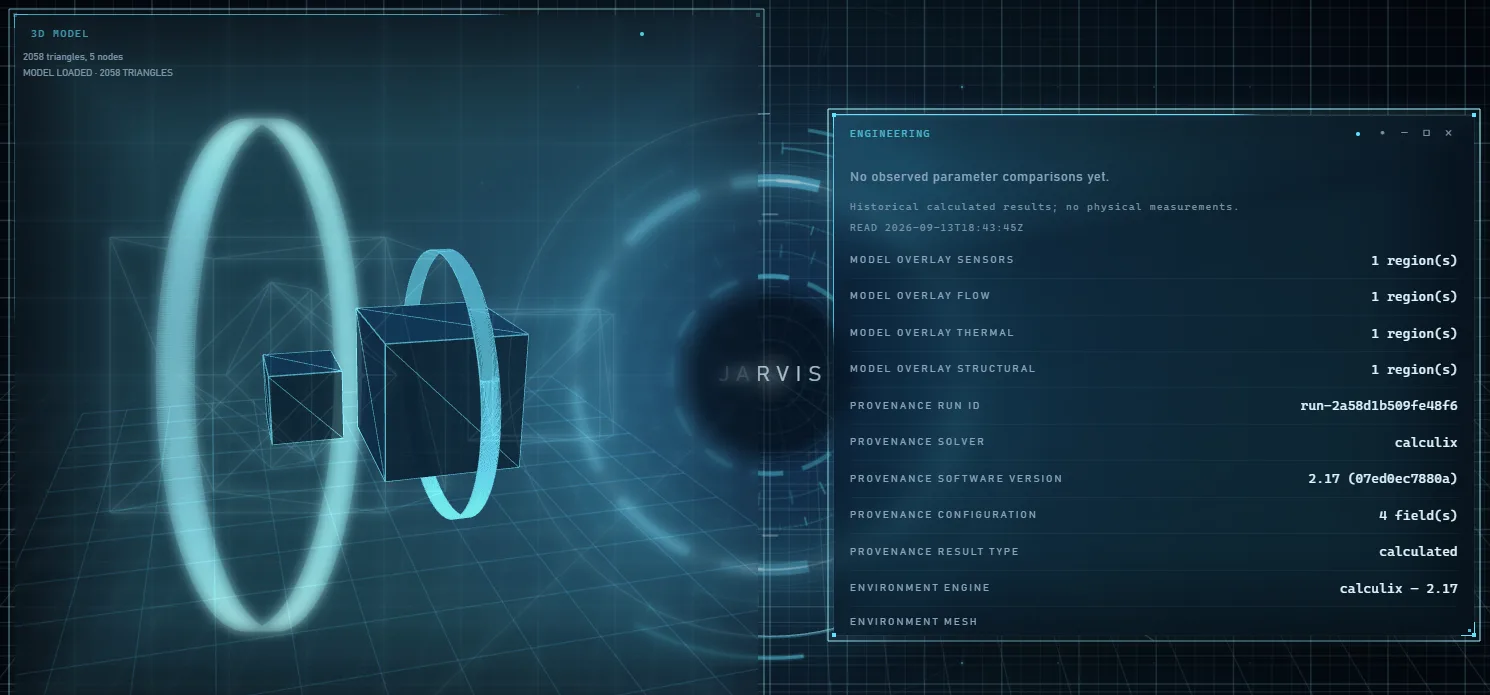
The JARVIS HUD showing a 3D model widget with a wireframe assembly beside an engineering panel listing a CalculiX run: provenance run ID, solver version 2.17 and result type 'calculated'.
Real capture, captured 13 September 2026. The ONE HUD after a live engineering journey. The panel labels its figures as historical calculated results with no physical measurements.
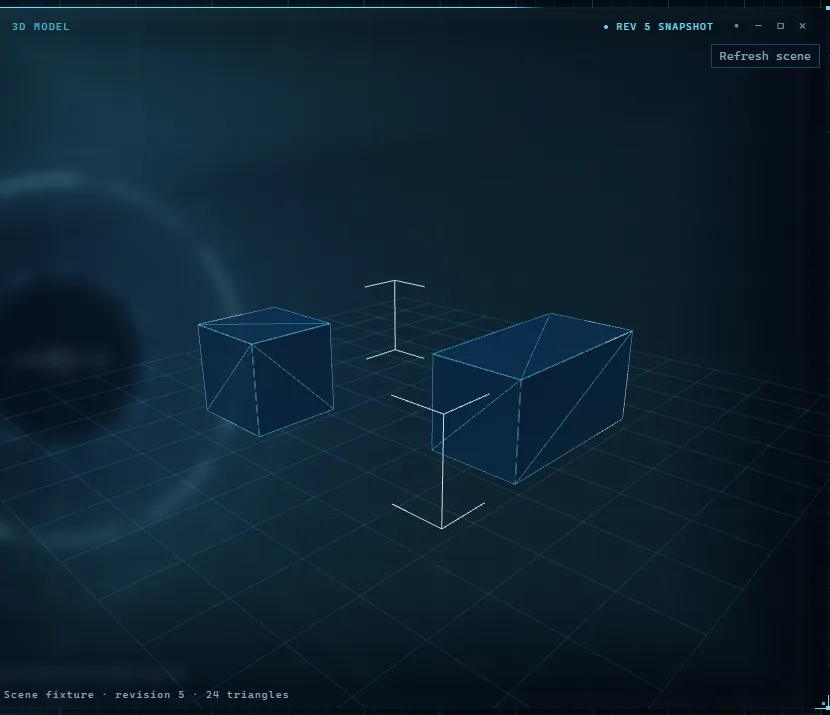
A 3D model widget in the HUD showing two wireframe boxes on a grid, labelled scene fixture, revision 5, 24 triangles.
Real capture, captured 22 September 2026. Advanced Systems branch (not merged into production): the revision-bound spatial scene rendering a synthetic fixture on 22 September 2026.
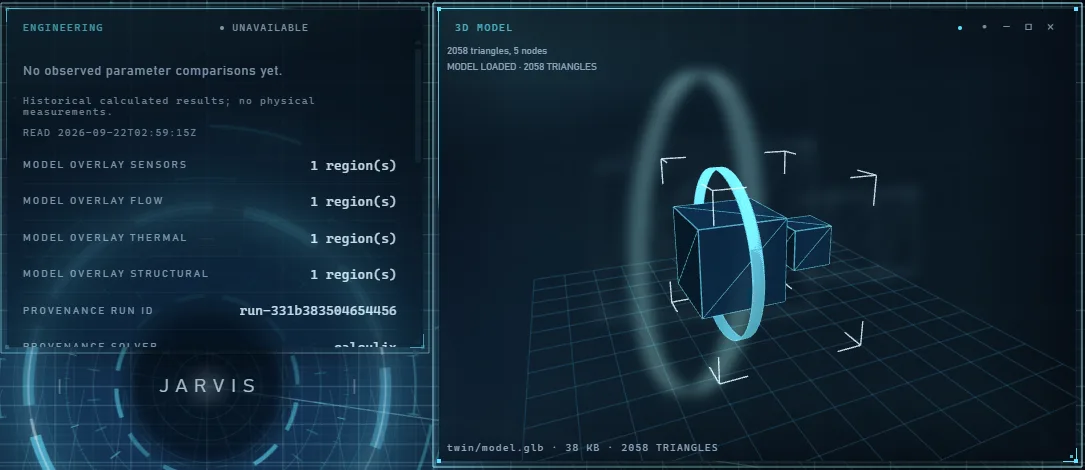
Two HUD panels: an engineering panel marked unavailable that lists calculated model overlays, and a 3D model widget with a wireframe cube assembly.
Real capture, captured 22 September 2026. The HUD on 22 September 2026 while the system reported DEGRADED. The engineering panel shows its data as unavailable rather than inventing values.
Real capture, captured 22 September 2026. The engineering model the HUD binds to, rendered from its own geometry: twin/model.glb, 2,058 triangles.
What happens, step by step
  1. 0:00 Digital twin · twin/model.glb · 2,058 triangles

Captured at revision 893913a9c

Status breakdown

Where each part stands

1 live-proven 4 integrated 2 tested 1 implemented 1 concept

  1. Units and the Quantity type Registry CAP-ENG-01 (unit errors rejected) LIVE on 2026-09-17. Historical after 24 h.
    LIVE-PROVEN , rung 6 of 8 OBSERVED Where: Production branch
  2. FreeCAD STEP operations and derivation journal Live on synthetic fixtures with an installed FreeCAD 1.1.x. Not merged into production.
    INTEGRATED , rung 4 of 8 CALCULATION Where: Advanced Systems branch (not merged)
  3. Spatial engineering workspace (SceneStore) 'Load STEP designs into the scene' is the only COMPLETE row of 857 in the Advanced matrix. Not merged into production.
    INTEGRATED , rung 4 of 8 FIXTURE Where: Advanced Systems branch (not merged)
  4. Trade spaces and resumable sweeps Not merged into production.
    INTEGRATED , rung 4 of 8 CALCULATION Where: Advanced Systems branch (not merged)
  5. STEP-to-mesh slicing and estimates Synthetic 10 mm cube: 325 s and 0.73 g, slicer estimates. Not merged into production.
    INTEGRATED , rung 4 of 8 ESTIMATE Where: Advanced Systems branch (not merged)
  6. CalculiX solve from a spoken request Runs a real solve under WSL and lights the engineering panel, in tests.
    TESTED , rung 3 of 8 TESTED Where: Production branch
  7. Print readiness (nine checks) Lane-only on the Advanced branch; software readiness only. Not merged into production.
    TESTED , rung 3 of 8 TESTED Where: Advanced Systems branch (not merged)
  8. Sandboxed OrcaSlicer with hashed job manifest Production body-matrix row A01. Its rung is not separately stated in the sources used here, so it is shown conservatively.
    IMPLEMENTED , rung 2 of 8 DOCUMENTED Where: Production branch
  9. Physical print start The final send always refuses today. There is no evidence JARVIS has ever started a print.
    CONCEPT , rung 1 of 8 NONE Where: Production branch

Pipeline

How it flows

From design to the printer door

  1. STEP or parametric model
  2. FreeCAD fixed script Advanced branch; no caller-supplied Python
  3. Derivation journal evidence_class CALCULATION
  4. Project revision compare-and-set, E-stop fence (can stop the request)
  5. 3D scene display placement only
  6. STEP to mesh via FreeCAD
  7. OrcaSlicer sandbox G-code report, hashed manifest
  8. Estimates time and filament, ESTIMATE
  9. Print readiness READY is software readiness (can stop the request)
  10. Approval request asking, not doing (can stop the request)
  11. Physical door refuses today (can stop the request)
Everything before the door is software. The door refuses today.

Diagrams are simplified from the code paths named in the sources below. They are illustrative, not screenshots.

Engineering is where the gap between a number on a screen and a fact in the world matters most. A stress value from a solver, a slicer’s print-time estimate and a caliper reading can all look like the same kind of number. They are not. JARVIS’s engineering layer is built to keep them apart, and to keep every software step apart from anything that moves a physical machine.

Units and quantities

All engineering maths uses a Quantity type that carries its dimensions across the seven SI base units. Converting a quantity straight to a plain number raises an error (“A quantity is not a number.”), so a value cannot silently lose its units halfway through a calculation. Unit errors are rejected. This is one of the capabilities the registry recorded LIVE, on 17 September 2026 (a historical reading).

Around this core, production has modules for reference frames, a parametric model, mesh validation and repair (writing STL and GLB), design of experiments, bounded optimisation, a run registry that records uncertainty, and a solver host. In tests, a spoken request can run a real CalculiX finite-element solve under WSL and light the engineering panel on the HUD.

CAD with FreeCAD (Advanced branch)

The Advanced Systems branch, which is not merged into production, adds governed FreeCAD operations on STEP files. They include booleans, centre and plane splits, component extraction, transform and mirror, edges and fillets, offsets, face listing and extension, and sealed hollowing. FreeCAD runs only fixed, isolated scripts: “No caller-supplied Python is executed.” A model or a web page cannot turn a CAD request into arbitrary code.

Every operation is journaled through four phases: PREPARED, CALCULATED, FILE_VERIFIED and REGISTERED. Every result carries evidence_class: CALCULATION. Project revisions use compare-and-set with E-stop commit fences, so two edits cannot silently overwrite each other and an E-stop can stop a commit. If an attempt is interrupted, it keeps its last durable phase for explicit reconciliation. It is never replayed blindly.

The limits are stated plainly. This is not a revision history graph, not a general feature engine and not natural-language CAD. A split is not an atomic two-file transaction.

There is also an open contradiction. Production’s own tool survey found FreeCAD absent from the system path, while the Advanced proofs used an installed FreeCAD 1.1.x. It is likely installed or located differently now, but that is uncertain.

The spatial engineering workspace (Advanced branch)

SceneStore holds a revision-bound 3D scene of at most 64 objects, 64 KiB and 4,096 revisions. It supports comparing revisions, labels and selective restore. It imports STL, OBJ and 3MF, displays STEP, and allows spinning a model under an E-stop lease. It renders with three.js inside the single HUD.

One rule stops the scene being mistaken for engineering truth: “Object transforms describe display placement, not CAD edits, fabrication dimensions, or observations of physical objects.” Moving a part on screen changes nothing about the design.

Trade spaces (Advanced branch)

A run registry records stamped values, evaluates constraints, archives evidence, draws a trade-off frontier and supports resumable sweeps, with plots on the HUD. The project is explicit about what a frontier is not: “Nominal frontier is not feasibility, causal comparability, uncertainty propagation, a global optimum, design promotion or physical approval.”

Slicing and print preparation

In production, OrcaSlicer runs as a sandboxed subprocess with exact profiles. It produces a G-code report and a job manifest with file hashes. The printer is reached over the local network, and its address must be private or loopback.

On the Advanced branch, STEP files are first converted to a verified slicing mesh through FreeCAD. This step exists because the installed OrcaSlicer 2.4.2 rejected STEP input, and that failure is kept as a receipt. The slicing commands publish time and filament estimates. For a synthetic 10 mm test cube, the slicer estimated 325 s and 0.73 g. That is an ESTIMATE on a fixture. Nothing was printed and nothing was weighed.

Print readiness, also Advanced-only, gives READY, NOT READY and WHY across nine checks. “READY IS SOFTWARE READINESS AND NOTHING MORE.”

Calculation, simulation, estimate, measurement, physical result

These five kinds of result are never merged, on the HUD or on this site:

Kind What it is Example in JARVIS What it cannot tell you
CALCULATION Computed from a model or formula Unit-checked arithmetic; FreeCAD STEP results stamped CALCULATION Whether the real part matches the model
SIMULATION A numerical model of behaviour A finite-element solve such as CalculiX’s How the physical part actually behaves
ESTIMATE A tool’s prediction of cost or duration The slicer’s 325 s and 0.73 g for a synthetic cube How long a real print took or what it weighed
MEASUREMENT An instrumented reading of a real object None recorded for a physical part in the evidence this site uses
PHYSICAL RESULT A real-world outcome that was inspected None. There is no evidence JARVIS has ever started a print.

Why so strict? A calculated value shown as measured invites trust it has not earned. On the HUD, computed and simulated values have their own colour, distinct from measured ones, and status is never carried by colour alone. The “verified physical results” surface renders only when a real evidence chain exists. The project treats a solver value appearing there as a truth-state violation. As one of its method lessons puts it: “Arithmetic about a property is not the property.”

The physical door

Printing is called “the first irreversible physical capability” in the project’s printer order. Starting a print needs all of the following:

  • a fresh, single-use approval bound to the G-code hash
  • a responsible-adult attestation
  • the E-stop clear
  • re-validated G-code
  • a proven stop path
  • nothing already printing

Today the final send always refuses. Pause and stop are the E-stop’s physical arm and are never gated, because stopping a machine must never wait on an approval. See governance.

What is not proven yet

  • No print has been started. Physical printing is a concept by design, and there is no evidence JARVIS has ever started one.
  • No physical measurement of a produced part appears in the evidence this site uses.
  • CAD, the 3D scene, trade spaces, STEP slicing and print readiness are on the Advanced branch only, not merged into production. Their live proofs used synthetic fixtures.
  • The CalculiX solve is tested, not live-proven.
  • FreeCAD availability in production is uncertain.
  • Registry engineering rows are mostly BLOCKED. They are CAP-ENG-03 to 31, and the project later partly corrected the reasons behind those blocks. The unit-safety LIVE reading dates from 17 September 2026.

Invariants

Rules the code enforces

  • A quantity is not a number.

    jarvis/engineering/units.py

  • No caller-supplied Python is executed.

    jarvis/engineering/freecad.py (Advanced branch, not merged)

  • Incomplete attempts retain their last durable phase for explicit reconciliation; they are never replayed blindly.

    Advanced Systems CAD derivations (branch, not merged)

  • Object transforms describe display placement, not CAD edits, fabrication dimensions, or observations of physical objects.

    jarvis/spatial/scene.py (Advanced branch, not merged)

  • READY IS SOFTWARE READINESS AND NOTHING MORE.

    Advanced Systems fabrication lane (branch, not merged)

  • Arithmetic about a property is not the property.

    docs/constitution/METHOD.md

Capabilities

Related capabilities

All 27 catalogued capabilities in this area

Sources

Sources

Paths are relative to the private JARVIS repository. They are listed so the claims above can be audited by the owner and reviewers; the files themselves are not published.

  • ledger docs/ledger/CAPABILITY_TRUTH.json
  • doc docs/orders/Z15_THE_FORGE.md
  • ledger docs/ledger/CRITICAL_PATH.md
  • doc docs/constitution/METHOD.md
  • ledger docs/ledger/CURRENT_BODY_EVIDENCE_MATRIX.md