Context
Acceptance journey J5 asks for research that “produces a cited artifact that opens correctly and distinguishes current evidence from assumptions.” The research desk browses in an isolated context, obeys robots.txt and refuses private hosts. Sources become evidence in a claim graph. Lexical matching can mark a claim CONSISTENT at most. Only an entailment check may call it ENTAILED, because “a keyword match must never be laundered into ‘verified’.”
The run
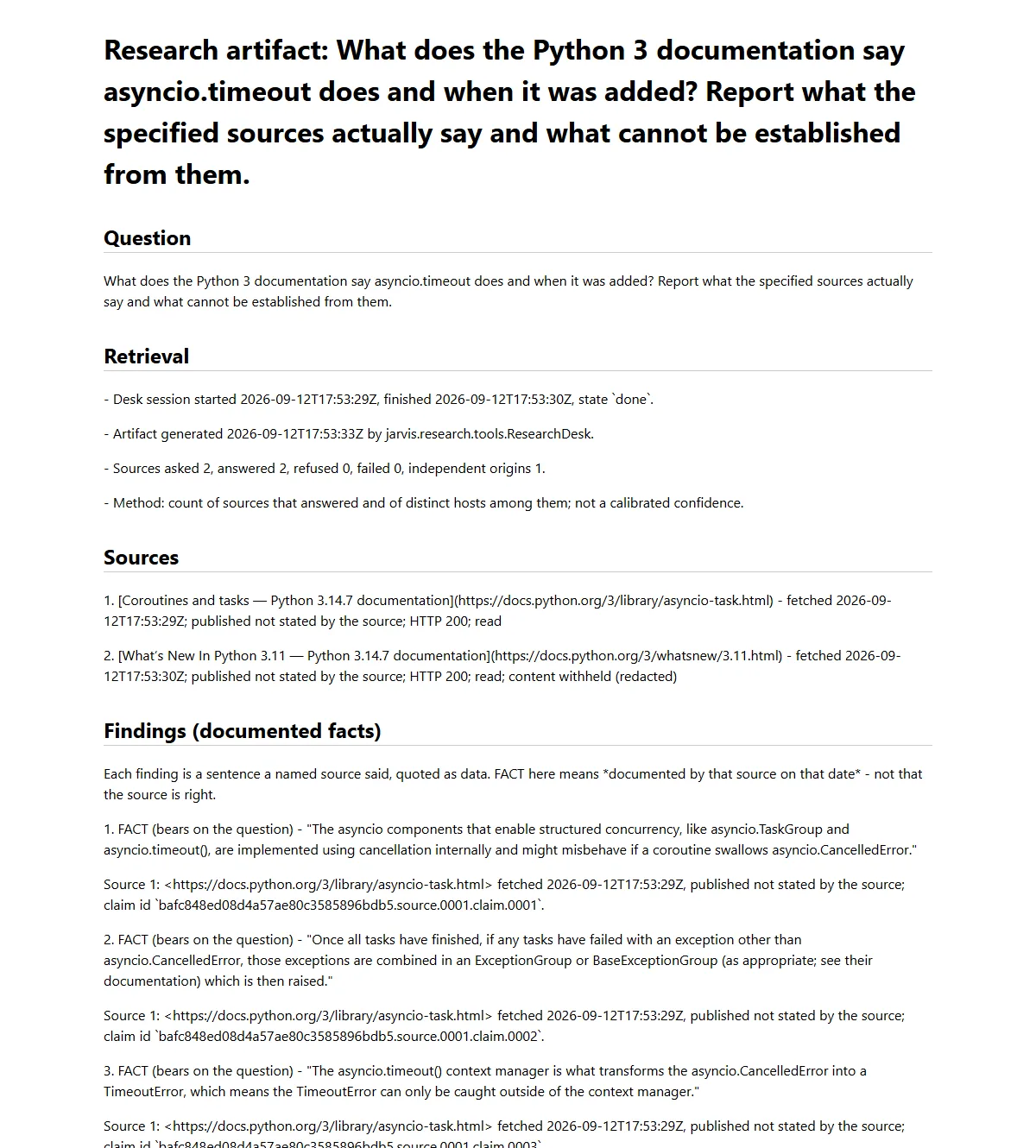
On the normal launcher with the conversation loop, hosted cognition and the typed inlet, the owner asked for research on a Python standard-library behaviour using exactly two named docs.python.org pages. research.run read both through the governed desk (HTTP 200, with fetch dates recorded) and made the dossier durable. The owner then asked for the research as a named artifact. research.artifact wrote a Markdown report and an HTML copy into the owner’s designated research folder through the governed file owner and read both back by digest.
The driver checked the result independently:
- the HTML rendered in headless Chrome with all nine required headings;
- the Markdown held six findings, each quoted from a named source with URL and fetch date;
- the contradictions section stated that none were detected, and said explicitly that this is not agreement;
- one assumption was marked NOT ESTABLISHED; there were no retrieval failures, and the untrusted-content notice was present;
- the HUD’s file-results widget showed the four governed receipts (two creates, two read-backs), without paths by design.
What failed first
The first drive exposed a real defect. The desk summarised each page’s opening prose instead of answering the question, and cited an interpreter start-up speed-up as if it were relevant. The repair makes the desk take question-focused sentences first. It reads 120,000 characters of a page instead of 40,000, and marks a sentence as relevant only if it contains two of the question’s terms. The drive was then repeated.
The evidence
Journey J5 in docs/orders/post-lm/ACCEPTANCE_JOURNEYS.json records the run, the checks and the repair. Commit b9c9b3dec marked it LIVE. The rendered artifact and HUD capture are local evidence files and are not published. No footage exists yet.
The limits
Two documentation pages make a narrow test. Neither source stated a publication date, and the artifact says so instead of inventing one. All journey readings predate the source of 17 September, so the project does not treat them as proofs of the current tree.