A thermal bench solve, asked for in plain words and filmed
On the booted production system, a typed request ran the thermal_bench solver case and opened the engineering panel. Both steps were verified; four values came back labelled calculated, with provenance and a stated modelling shortcut. The turn took 5.1 s.
LIVE-PROVEN, rung 6 of 8What this run supports. Recorded 22 September 2026.
Real capture22 Sept 2026engineering22 s1080p · 60 fps
Asked: “Run the thermal bench simulation and show me the engineering results.”
Real capture, captured 22 September 2026. JARVIS ran the thermal_bench case (run-8a6b69c66acd4dbe): efficiency 0.31358, 593.15 K, 376.296 W, 1.269 GPa, all labelled calculated. The whole turn took 5.1 s.ShowsA request reaches a real solver through the policy check, and the result is published with its provenance and stated assumptions.Does not showCalculated, not measured. The panel’s provenance run ID lagged the new run until a restart.What happens, step by step
0:00 Asked: “Run the thermal bench simulation and show me the engineering results.”
0:07 Solver run published: provenance, solver, software revision, stated assumptions
0:16 The digital twin the readings belong to
Captured at revision 893913a9c
Real capture22 Sept 2026engineering
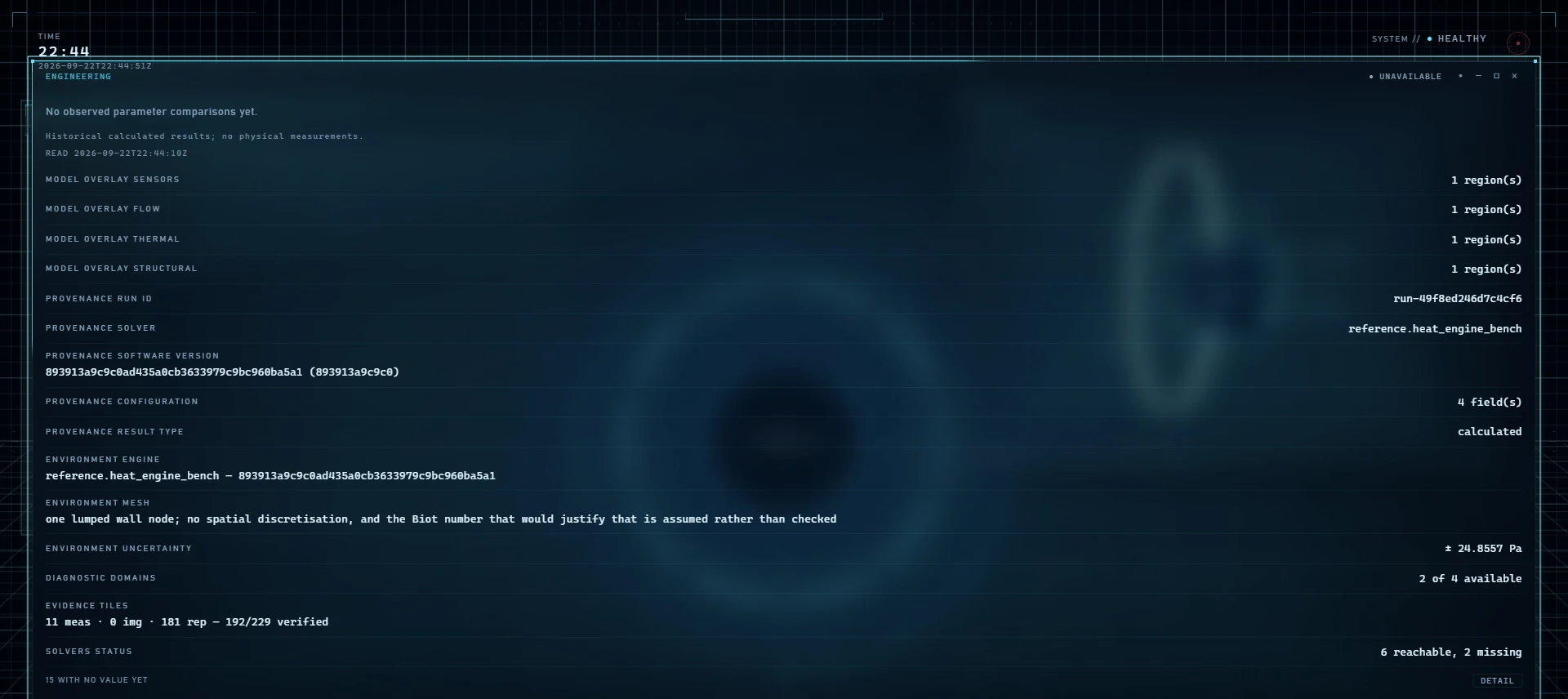
Real capture, captured 22 September 2026. What a published solve carries: its run, solver, software revision, result type, the model’s own simplification and its uncertainty.
Captured at revision 893913a9c
Real capture22 Sept 2026engineering24 s1080p · 60 fps
Digital twin · twin/model.glb · 2,058 triangles
Real capture, captured 22 September 2026. The engineering model the HUD binds to, rendered from its own geometry: twin/model.glb, 2,058 triangles.What happens, step by step
0:00 Digital twin · twin/model.glb · 2,058 triangles
Captured at revision 893913a9c
Asked
What was asked
Run the thermal bench simulation and show me the engineering results.
Result
What happened
JARVIS planned two steps. engineering.solve ran the thermal_bench case (run-8a6b69c66acd4dbe) after the policy check allowed it under the owner's standing authorisation, and published efficiency 0.31358, 593.15 K, 376.296 W and 1.269 GPa, each labelled calculated with its uncertainty. The second step opened the engineering panel. It answered: "Check. Done. The engineering widget is up."
Pipeline
Architecture path
01Typed request
02Hosted cognition plans two steps
03Policy check (standing authorisation)
04Reference solver: thermal_bench
05Values published with provenance
06Engineering panel opens
07Spoken answer
What this proves
A plain-language request reaches a real solver through the policy check, on the production revision, on the real machine.
Published values carry their provenance: run ID, solver, software revision, result type and uncertainty.
The model's own shortcut is shown to the owner: one lumped wall node, with the Biot number assumed rather than checked.
What it does not prove
Calculated is not measured: no physical bench exists behind these numbers.
The panel's provenance line still showed the previous run's ID until the system was restarted; the new run appeared after the restart.
Recorded on 2026-09-22; a recorded run is not a current reading.
A second request in the same session, run the tensile bar case and then open the 3D model, ran the solve but dropped the second step.
Context
The engineering route runs a real solver case and publishes its values to the HUD. The owner declared engineering.solve standing-authorised, so it does not stop for approval. The route still asks the policy engine on every call, because a check that is skipped when a yes is expected is a check that cannot fail.
The run
The request was typed into the running conversation, through the same path as speech. It uses the same loop, tools and policy. JARVIS planned engineering.solve(case=thermal_bench) and then hud.widget(open engineering). Both steps came back VERIFIED, and the whole turn took 5.1 s.
Reading
Value
Label
Efficiency
0.31358
calculated
Temperature stability
593.15 K
calculated
Power output
376.296 W
calculated
Material stress
1.269 GPa (± 24.9 Pa)
calculated
Maximised, the panel shows more than numbers. It gives the solver (reference.heat_engine_bench) and the software revision. It also states the model’s own simplification: “one lumped wall node; no spatial discretisation, and the Biot number that would justify that is assumed rather than checked”. It reports that 6 solvers are reachable and 2 are missing.
The limits
The provenance line lagged: during the session it still showed the previous run’s ID. After a restart the panel showed the new run. The values are calculations from a reference bench, not measurements of hardware. A later compound request ran its solve but silently dropped the step that should have opened the 3D model.